

Stake Originals
Stake OriginalStake Tarot: Three Cards and a Multiplier
Guide to Stake Tarot: three cards, coefficients, difficulty, multiplier calculation, Manual and Auto modes, and provably fair verification.
Published by The Gambling Desk ·
Stake Tarot is not a game of French tarot and involves no bidding, tricks or hand building. It is an instant Stake Original: three illustrated cards are revealed, each carries a coefficient, and their combination determines the final multiplier.
The player selects only the bet and a difficulty level before pressing Bet. They do not select a card or make any decision between the reveals.
How a Round Works
- Set the Bet Amount.
- Choose the Difficulty.
- Start the round with Bet.
- The centre card is revealed.
- The left and right cards then complete the draw.
- The game displays the total multiplier and payout.
The DOCX describes the order as centre, left, right. If a side card is worth 0x, the product becomes zero and the bet is lost. There is no sequence to continue and no cashout in the observed interface.
Understanding the Tarot Interface
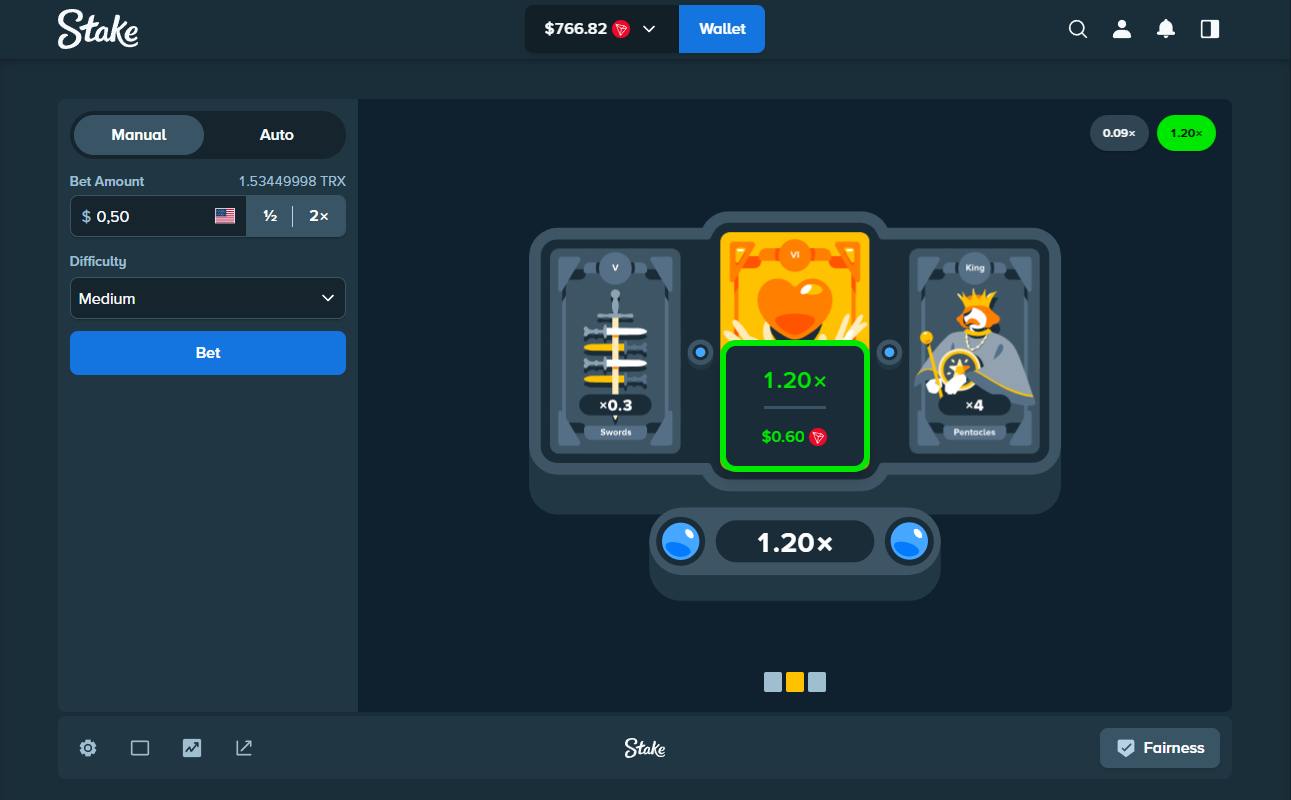
The Manual and Auto tabs appear at the top of the left-hand panel. Bet Amount sets the stake and offers shortcuts to divide or double it. The Difficulty menu selects the distribution profile; the screenshot shows Medium.
The three cards occupy the centre. The visible left card is the Five of Swords at 0.3x; the right card is a King of Pentacles at 4x. The central VI card completes the calculation. The displayed result is 1.20x, or 0.60 for a bet of 0.50.
Recent results appear at the top right. The three markers beneath the mechanic correspond to the progress of the reveals. Fairness opens the verification module.
Inside the Stake interface
Stake Original Tarot in pictures

Cards, Arcana and Coefficients
The DOCX distinguishes a centre card drawn from the major arcana and two side cards drawn from the minor arcana. The centre card provides the base coefficient; the left and right cards then adjust that result.
The imagery draws on tarot, but the resources provide neither the complete composition of the deck, the exact number of possible cards nor an exhaustive canonical coefficient table. It should therefore not be assigned the 78 cards or rules of traditional tarot.
The illustrations identify the results. They cannot predict the next card, and two cards with familiar names do not follow the rules of blackjack or Hilo.
Calculating the Multiplier
The formula described in the DOCX is:
bet × left coefficient × centre coefficient × right coefficient
In the screenshot, 0.3 × 1 × 4 produces 1.20x. With a bet of 0.50, the total payout is 0.60 and net profit is 0.10.
The multiplier describes the total return applied to the bet. The payout is the amount actually returned; net profit subtracts the initial stake. A card with a high coefficient does not guarantee a profit if another card reduces or cancels the product.
Difficulty and Auto Mode
The difficulty level changes the distribution of coefficients and therefore the variability of results. The legacy DOCX mentions Easy, Medium, Hard and Expert, along with several maximum values, but only the presence of the menu and the Medium value are visible in the current screenshot. The legacy maxima are therefore not published as guaranteed current limits.
Auto mode is visible, but its detailed settings are not confirmed. It repeats rounds according to a configuration; it changes neither the formula nor the distribution associated with the difficulty.
Results, Losses and Strategy
A product above 1x returns more than the stake, 1x returns it, and a product below 1x returns less than the amount wagered. A side coefficient of 0x cancels the payout according to the legacy DOCX.
Past results do not make any card or family of arcana more likely. Changing difficulty alters the risk profile, not the ability to predict the draw. Increasing the bet does not offset low or zero products.
An RTP of 98%, a 2% house edge and a maximum of 5,000x appear in the legacy DOCX, but no separate current canonical data confirms them in the repository. They are therefore not presented as guaranteed features.
Advice and Limitations
- select the difficulty before starting;
- check the Bet Amount;
- distinguish the multiplier from net profit;
- do not interpret the arcana as signals;
- limit the number of rounds in Auto;
- do not continue in an attempt to recover a loss.
Tarot and Provably Fair
The Fairness access allows the draw to be verified retrospectively using the seeds and nonce. It does not reveal the next three cards.
Our Stake provably fair guide explains this verification. Diamonds provides a comparison with another instant result based on several symbols, while Hilo uses a different card mechanic with successive decisions.
Frequently Asked Questions
Does Stake Tarot Follow the Rules of French Tarot?
No. The observed interface reveals three cards with coefficients and calculates a multiplier; it includes neither tricks nor bidding.
How Is the Payout Calculated?
The bet is multiplied by the left, centre and right coefficients. The displayed result is a total return, from which the bet must be subtracted to determine net profit.
Does Difficulty Make the Cards Easier to Predict?
No. It changes the coefficient profile but does not make the next draw predictable.