

Stake Originals
Stake OriginalStake Crash: Multiplier, Cashout and Risks
A guide to Stake Crash: how a round works, the multiplier, manual or automatic cashout, history, and Manual and Auto modes.
Published by The Gambling Desk ·
Crash is a multiplayer Stake Original in which a multiplier increases during the round and then stops at a random moment. The player must cash out before that stop: a confirmed cashout pays the bet at the multiplier reached, while a crash that occurs before cashout forfeits the bet.
The simplicity of the action does not make the result predictable. The graph and history describe what is happening or has already happened; they do not reveal the stopping point of the next round.
How a Crash Round Works
- Set the bet amount before the next round.
- Optionally choose an automatic cashout threshold.
- Confirm the bet during the designated period before the round starts.
- Watch the multiplier rise from 1x.
- Cash out manually before the crash, or let the automatic threshold act if it is reached.
If cashout is confirmed at 2x with a bet of 5 units, the total return is 10 units. If the crash occurs before cashout is confirmed, the bet for the round is lost. The value shown on screen is therefore not secured until cashout has been registered.
Understanding the Crash Interface
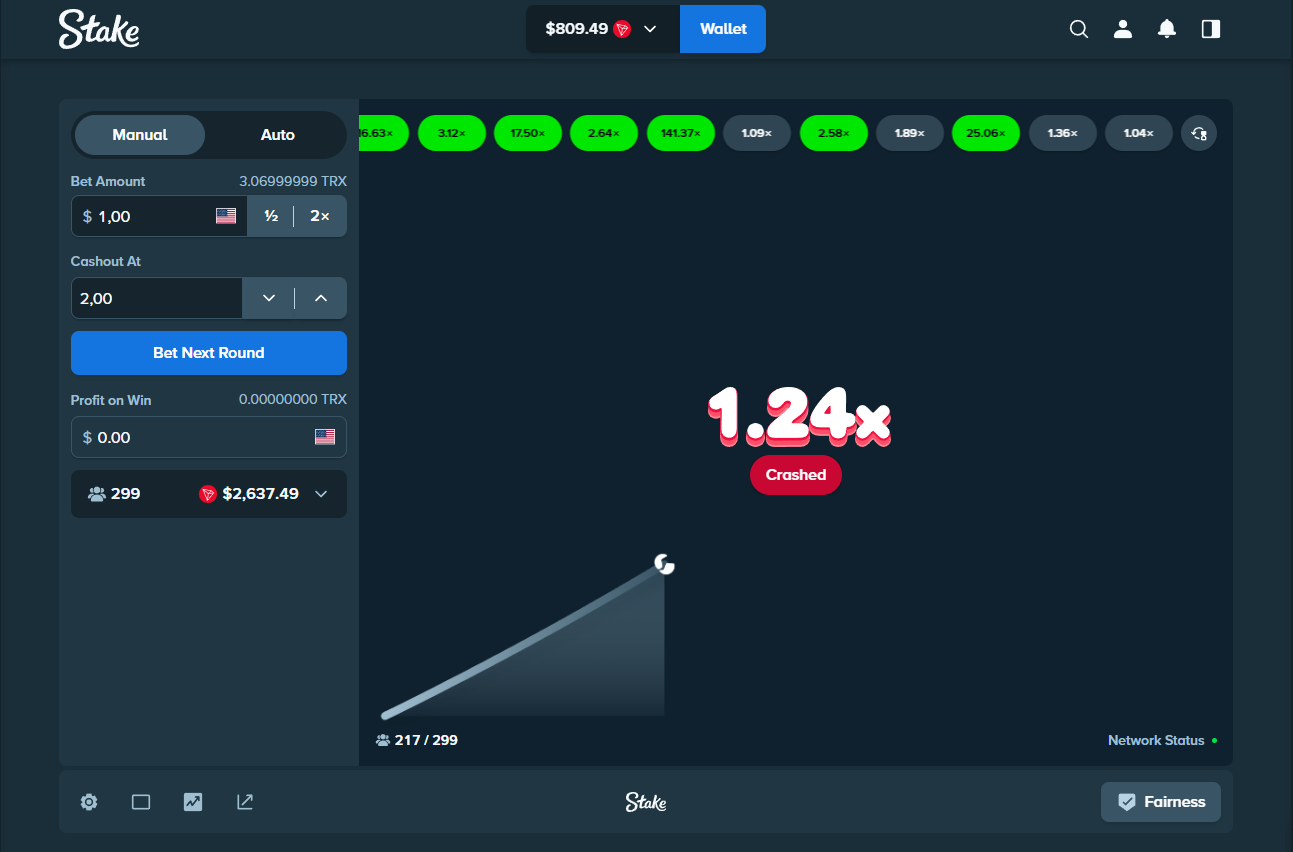
The screenshot shows Manual mode, the bet amount, the “Cashout At” threshold and the “Bet Next Round” button in the left-hand panel. The centre displays the graph and stopping point, while multipliers from previous rounds appear at the top.
The panel also shows the potential profit associated with the selected threshold. The central area lets you follow the current round, number of participants and final multiplier once the crash has occurred. The “Fairness” access is located at the bottom of the interface.
Inside the Stake interface
Stake Original Crash in pictures

Manual and Automatic Cashout
Manual cashout lets the player choose when to exit during the rise. The longer the wait, the higher the potential return, but the greater the exposure to a crash before cashout.
Automatic cashout sets an exit multiplier in advance. It can prevent a late reaction when the target is reached, but it does not make that target more likely. A low threshold is reached more often than a very high one, in exchange for a lower payout.
Some Crash interfaces offer multiple betting panels. They allow two separate bets or thresholds to be prepared for the same round. This option does not reduce risk: it can increase total exposure if both bets are active.
Manual and Auto Modes
In Manual mode, every bet is prepared and confirmed separately. Auto mode repeats a configuration across several rounds. The sources document a number of bets, bet amount, cashout threshold, adjustment rules after a win or loss, and stopping limits.
These automatic settings execute instructions; they do not detect favourable rounds. A progression after a loss can make the bet grow very quickly. Before using Auto, set a number of rounds and maximum loss compatible with your budget.
Reading the History without Looking for a Signal
The markers at the top show the multipliers from completed rounds. They are useful for reviewing a session or checking a result, but not for predicting the next crash.
A run of low multipliers does not guarantee a high round. A long rise does not make the next round shorter either. Changing the bet or threshold in response to a sequence does not change the random result of the next round.
Tips and Limits
- check the bet and threshold before confirming the wager;
- distinguish the total return from the net profit;
- avoid last-second exits;
- limit the number of rounds in Auto mode;
- do not chase a high multiplier to recover a previous loss;
- never treat the history as a predictive indicator.
A cautious target changes the frequency and amount of cashouts, not the game’s mathematical house edge. No threshold or betting system guarantees a profit.
Crash and Provably Fair
Crash uses Stake’s provably fair mechanism. The seeds and nonce allow you to check afterwards that the stopping point resulted from the calculation committed to for the round. This verification does not reveal the result before the round.
Our guide to Stake provably fair explains the role of the server seed, client seed and nonce, as well as the difference between auditing and prediction.
Frequently Asked Questions
What Happens If I Cash Out before the Crash?
Once cashout is confirmed, the return corresponds to the bet multiplied by the recorded multiplier. Merely seeing a value on screen is not enough if cashout was not confirmed.
Does Automatic Cashout Improve the Probabilities?
No. It executes an exit at the defined threshold if the graph reaches it. It changes neither the crash point nor the probability of reaching that threshold.
Can You Predict a Round from the History?
No. Previous multipliers describe completed rounds. They create neither a guaranteed cycle nor compensation on the next round.