

Tables / Stake Originals
Stake OriginalStake Mines: Rules, Multipliers and Table
A guide to Stake Mines: the 25-tile grid, choosing the number of mines, safe tiles, cashout, Manual and Auto modes, and the multiplier table.
Published by The Gambling Desk ·
Mines turns a 25-tile grid into a series of simple decisions: reveal another tile or cash out. Every gem found increases the available multiplier. Revealing a mine immediately ends the round and forfeits the bet.
The player chooses between 1 and 24 mines before the round begins. This setting changes the number of safe tiles, the probability of a successful next selection, and the speed at which the multiplier grows.
How to Play Stake Mines
- Set the bet and number of mines.
- Start the round: the mines are then placed randomly among the 25 tiles.
- Select a tile. A gem allows play to continue and increases the multiplier; a mine ends the round.
- After every gem, choose whether to open another tile or use cashout to collect the displayed return.
The positions are not revealed in advance. The random selection button chooses a tile on your behalf, but it does not improve the probability of finding a gem.
Understanding the Interface and Settings
The 25-tile grid occupies the centre of the screen. The side panel contains the bet, number of mines and the control for switching between Manual and Auto modes.
In Manual mode, you select every tile and decide when to cash out. Auto mode repeats a configuration defined in advance. It accelerates the rounds without making tiles more predictable or changing the game’s mathematical house edge.
During a round, the interface shows the current multiplier and potential return. Always check the displayed amount before continuing: until cashout is completed, that amount remains exposed to the next selection.
Inside the Stake interface
Stake Original Mines in pictures

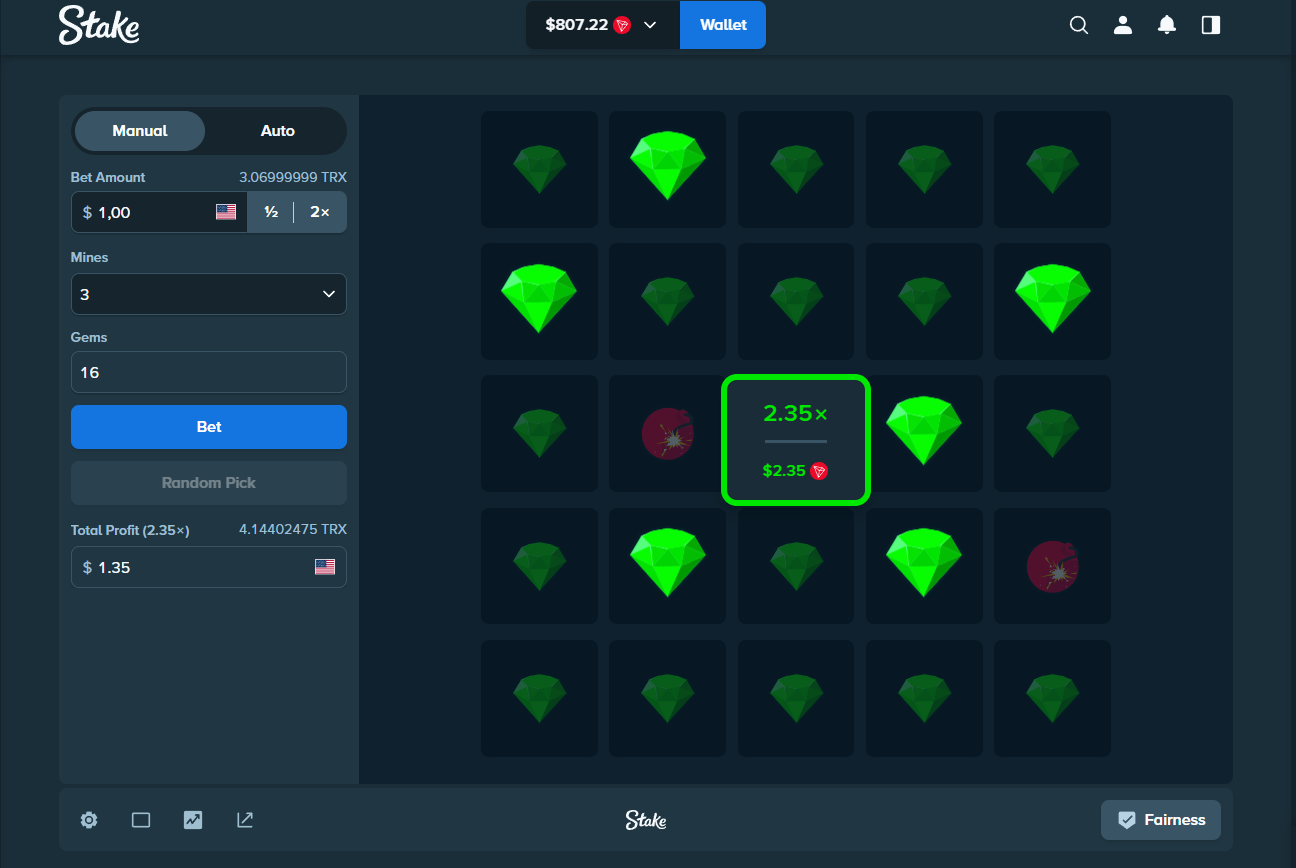
Number of Mines, Probability and Multiplier
With a single mine, 24 of the 25 tiles are safe on the first selection, so the multiplier starts at 1.03x. With 10 mines, only 15 tiles are safe and the first gem pays 1.65x. With 24 mines, only one tile is safe and its multiplier reaches 24.75x.
These values illustrate the central trade-off in Mines: adding mines increases the possible payout from a successful selection but reduces its probability. Continuing after finding a gem has the same effect. No number of mines makes the game profitable or risk-free.
Mines Multiplier Table
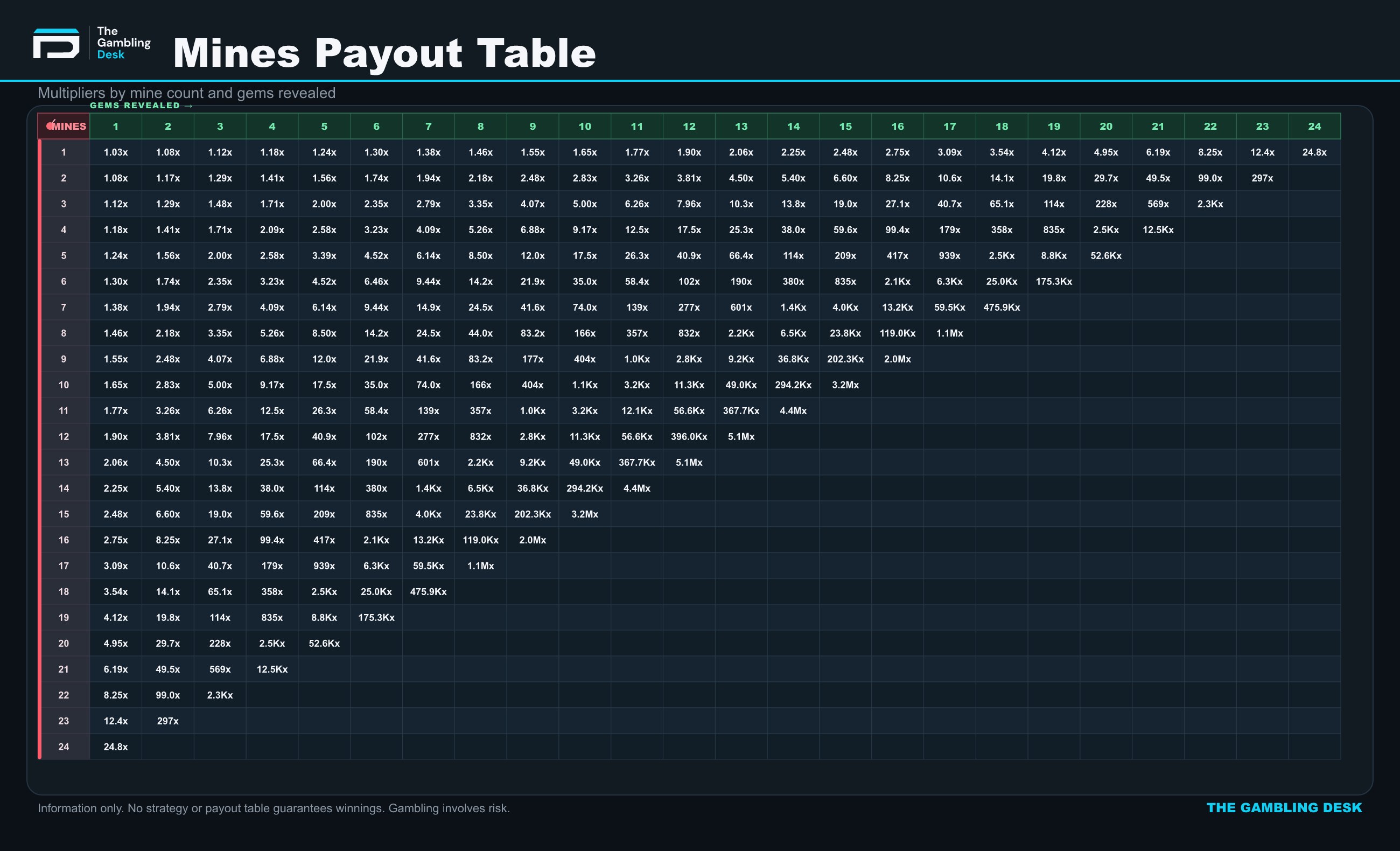
The first column shows the number of mines. The “1g”, “2g” and subsequent columns correspond to the number of gems already revealed. For example, with one mine, the table shows 1.03x after one gem and 1.08x after two. Blank cells represent impossible situations because the number of available gems decreases as the number of mines rises.
The branded table brings together the reference values and can be opened at full size to make it easier to read.
Calculating a Return and Net Profit
The multiplier describes the total return, including the bet. A bet of 10 units cashed out at 2x produces a return of 20 units. The net profit is therefore 10 units, not 20.
This calculation does not predict the next tile. If a mine is revealed before cashout, the bet is lost and the previously displayed multiplier is not paid.
Tips for Discovering Mines
- start with a small bet to observe how the grid works;
- choose the number of mines before starting the round and do not confuse it with a target number of gems;
- compare rows in the table at the same number of gems;
- set your limit before using Auto mode;
- do not mechanically double the bet in an attempt to recover a loss.
Reducing the number of mines lowers the volatility of a selection, but it eliminates neither chance nor the house edge. A previous sequence cannot locate the mines in the next round.
Mines and Provably Fair
Stake documents Mines as one of its provably fair games. After the server seed is rotated, the game data can be used to verify the sequence that determined the positions. This check confirms the integrity of the result afterwards; it does not reveal the safe tiles before the bet.
Our guide to Stake provably fair explains the role of the server seed, client seed and nonce.
Frequently Asked Questions
Can You Cash Out after Every Gem?
Yes. After a safe tile, cashout collects the return corresponding to the displayed multiplier. Continuing exposes that potential return to another mine.
Does Adding Mines Increase the Chances of Winning?
No. It reduces the number of safe tiles. The multiplier for a success rises precisely because the selection becomes riskier.
Does Auto Mode Choose a Better Strategy?
No. It executes the parameters set by the player. It does not know the mine positions and guarantees no result.