

Stake Originals
Stake OriginalStake Hilo: Cards, Probabilities and Cashout
A guide to Stake Hilo: choosing Higher or Same or Lower or Same, reading the probabilities, building a card sequence, skipping and cashing out.
Published by The Gambling Desk ·
Hilo displays a card and then asks whether the next one will be higher or lower. The observed interface phrases the two choices as “Higher or Same” and “Lower or Same”, so a card of the same value is included in the displayed options. A correct answer extends the sequence and increases the multiplier; an incorrect answer ends the round.
After every success, the player can continue with the new card or cash out the accumulated return. Chaining choices increases the potential payout, but adds another condition that must be met each time.
How a Game Works
- Set the bet amount and start the round.
- Observe the visible card and the probabilities associated with both choices.
- Select Higher or Same or Lower or Same.
- If the choice is correct, check the new multiplier.
- Continue, use Skip Card or cash out according to the available controls.
The return is only secured after a confirmed cashout. If a losing selection occurs before cashout, the multiplier accumulated during the sequence is not paid.
Understanding the Hilo Interface
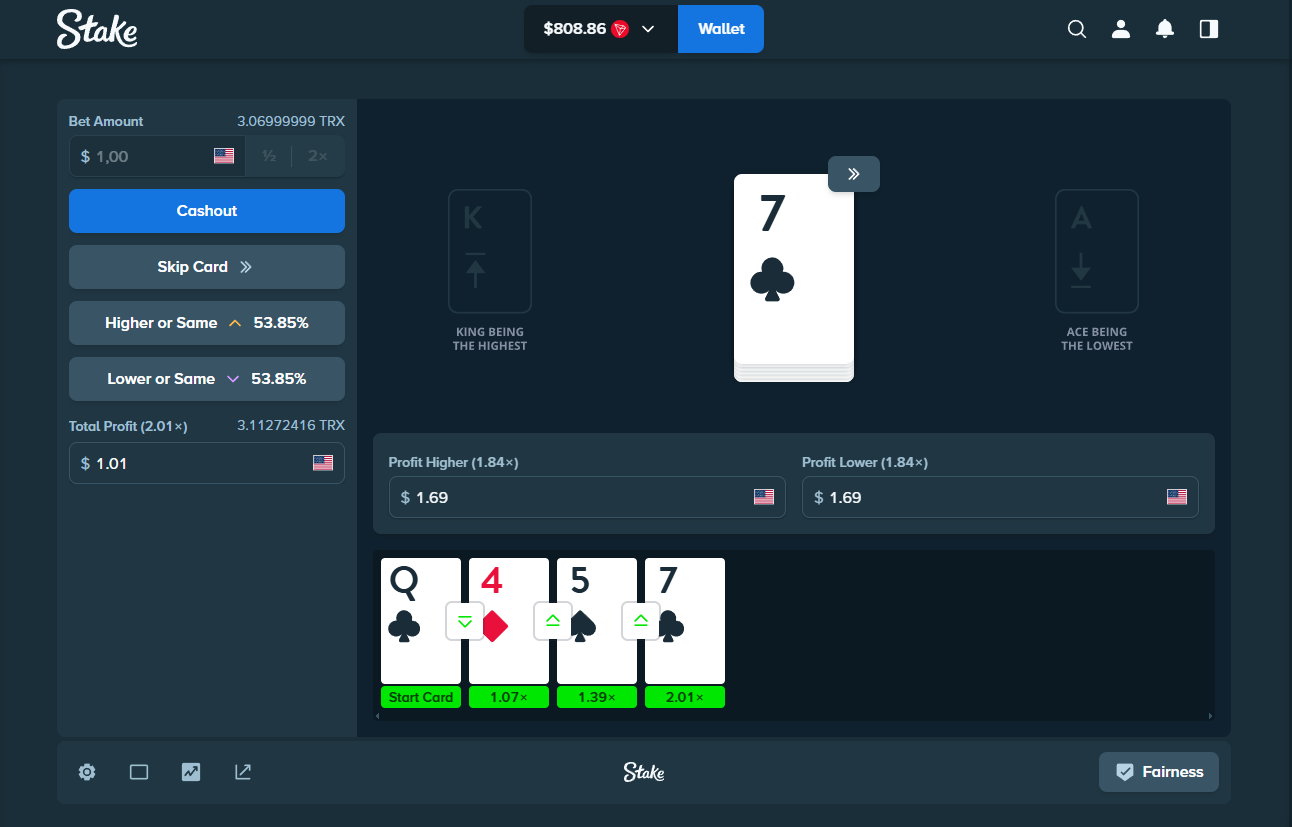
The screenshot shows the bet amount, cashout, “Skip Card”, “Higher or Same” and “Lower or Same” in the left-hand panel. The current card occupies the centre; possible profits and the sequence history appear below it.
The visible card is a 7. Both choices then display 53.85%, with the same potential profit at 1.84x. The markers at the sides show that the King is the highest value and the Ace the lowest in this interface.
Inside the Stake interface
Stake Original Hilo in pictures

Higher, Lower and Matching Cards
The probability depends on the current value. With a low card, Higher or Same covers more ranks. With a high card, Lower or Same generally becomes the wider choice. Near the middle, both probabilities may be close.
The observed labels explicitly include “or Same”. However, the old source document mentions particular rules for the extreme values without allowing them to be fully confirmed from the screenshot. You should therefore always rely on the probabilities and labels shown by the active interface instead of extending this rule to a case that is not visible.
A more likely choice offers a lower multiplier. Choosing the less likely side increases the potential payout but also the risk of immediately ending the sequence.
Skip Card and Cashout
“Skip Card” lets you pass the current card without making a prediction. The screenshot shows this control during an active round. It is used to change the proposed decision, not turn an unfavourable card into a win.
Cashout ends the sequence at the accumulated multiplier. Continuing after a correct answer keeps the return as a potential value only. Before every new choice, compare that return with the risk of adding another step.
Manual and Auto Modes
Manual mode lets the player decide on every card. The sources also document an Auto mode capable of repeating choices and settings across multiple rounds. Only options visible in the active interface should be used, with a number of rounds and stopping limits.
Automation does not read the next card. A repeated rule can accelerate the sequence of bets and losses. It must be capped before it starts.
History and Probabilities
The history at the bottom traces the cards and multipliers in the sequence. It helps review the progression but cannot predict the next card.
The decision must be based on the probabilities displayed for the current card. A sequence of high or low cards does not guarantee a correction on the next draw. Hilo is not a physical shoe whose remaining composition is known to the player.
Tips and Limits
- check the probability and multiplier before every choice;
- distinguish potential profit from a return already cashed out;
- use Skip Card as a pass control, not as a predictive strategy;
- set a limit on the number of consecutive decisions;
- avoid increasing the bet to recover a lost sequence;
- do not infer a trend from the history.
A more frequent choice does not guarantee lasting profit. It generally reduces the multiplier, while a single incorrect decision can end the round before cashout.
Hilo and Provably Fair
Hilo uses Stake’s provably fair data to produce the card sequence. Once the server seed has been revealed, the results can be checked using the client seed and nonce. Verification takes place afterwards and does not reveal the next card.
Our guide to Stake provably fair explains this procedure and its limits.
Frequently Asked Questions
What Do Higher or Same and Lower or Same Mean?
These labels indicate that the choice concerns a higher or matching card, or a lower or matching card. For extreme values, always check the probability and rule displayed in the active interface.
Can You Cash Out after a Correct Answer?
Yes. Cashout ends the sequence at the accumulated multiplier. Continuing exposes that potential return to another decision.
Can the History Predict the Next Card?
No. It describes the sequence played. Previous cards do not guarantee the value of the next one.