

Stake Originals
Stake OriginalStake Plinko: Rows, Risk and Multipliers
Guide to Stake Plinko: ball, peg grid, 8 to 16 rows, Easy to Expert difficulty, multipliers, Manual and Auto modes.
Published by The Gambling Desk ·
Plinko drops a ball from the top of a pyramid of pegs. At each obstacle, its path continues to the left or right until it reaches a final slot bearing a multiplier. The player selects the bet, difficulty and number of rows before the drop.
The animation does not allow you to steer the ball. The final slot is determined by the draw: clicking on one side of the grid or waiting for a supposedly favourable area does not change its probability.
How a Round Works
- Set the bet amount.
- Choose a difficulty: Easy, Medium, Hard or Expert.
- Select between 8 and 16 rows.
- Check the distribution of multipliers beneath the grid.
- Drop the ball and wait for it to land in a slot.
The multiplier in the final slot is applied to the bet. A value below 1x returns less than the amount wagered; a high value corresponds to a much less frequent slot.
Understanding the Plinko Interface
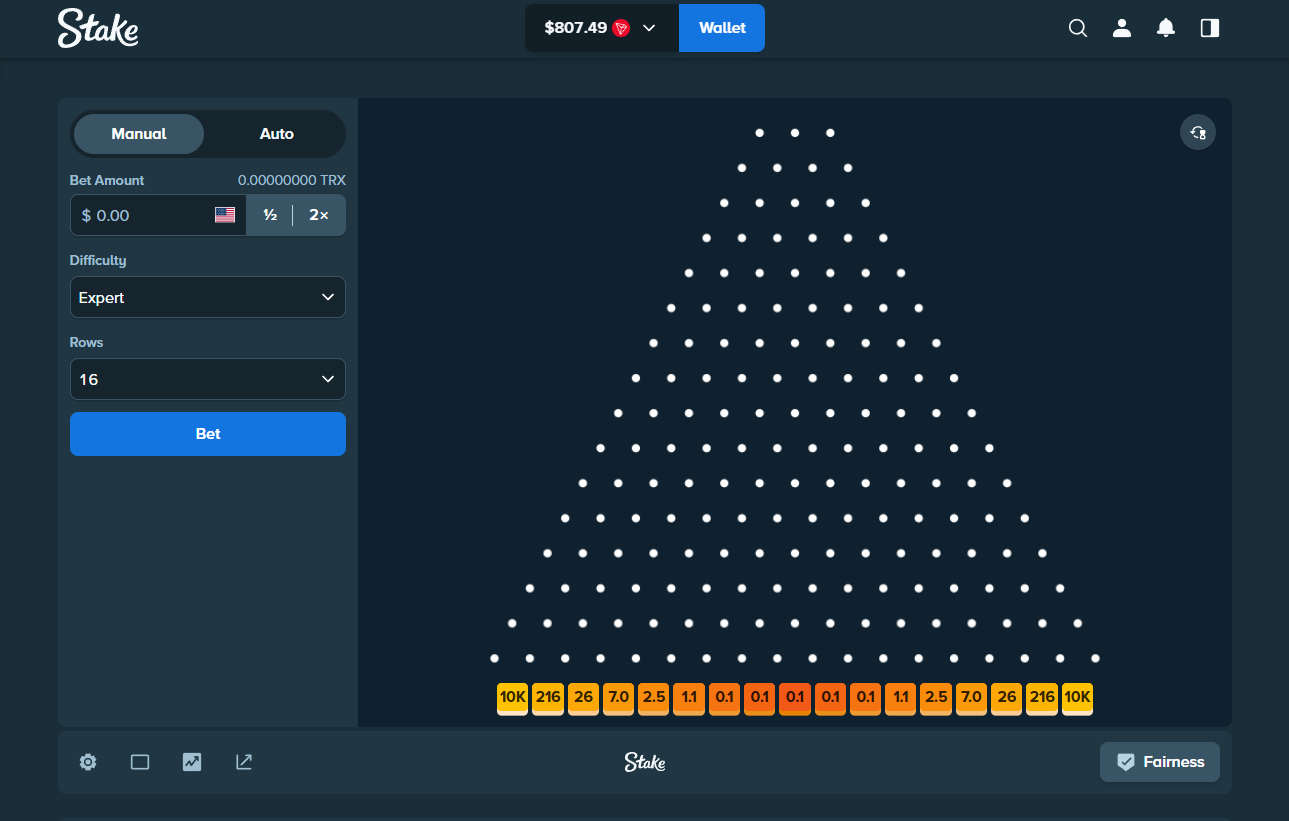
The screenshot shows Manual and Auto modes, the bet, difficulty and number of rows in the left-hand panel. The peg pyramid occupies the centre, and the multiplier slots appear below the final row.
The visible configuration uses Expert and 16 rows. The centre slots display 0.1x, while those at the edges display 10K. These values describe only this observed configuration and do not constitute a canonical table for every variant.
Inside the Stake interface
Stake Original Plinko in pictures

Rows and Risk Levels
The number of rows determines the length of the path and the number of final slots. With more rows, the distribution contains more positions, and extreme configurations can display a wider range of multipliers.
The difficulty changes the shape of this distribution. Easy concentrates more results around moderate payouts. Medium and Hard broaden the variation. Expert places the highest multipliers at the edges and the lowest returns in the centre.
The centre slots can be reached through a greater number of possible paths. Reaching an edge requires a far rarer succession of movements in the same direction. A high multiplier therefore does not mean that it is close to being hit.
Manual and Auto Modes
In Manual mode, each ball is dropped separately. Auto repeats the selected settings for a defined number of rounds. The documented options may also include profit or loss limits and bet adjustments.
Each ball represents a separate bet, even when several animations are visible at the same time. Set a number of rounds and a maximum loss before enabling Auto. Increasing the bet after a loss can quickly raise the total amount wagered.
Advice and Limitations
- check the difficulty and rows before every series;
- compare the entire distribution, not only the maximum value;
- distinguish a return below 1x from a net profit;
- do not try to aim for a slot with the cursor;
- do not interpret previous results as a trend;
- limit the number of balls in Auto mode.
Changing the risk alters volatility, not the randomness of the next result. No combination of rows and difficulty guarantees a profit.
Plinko and Provably Fair
A Plinko result can be checked using the server seed, client seed and nonce. After the server seed is revealed, the sequence of left/right decisions and the final slot can be reproduced.
Our Stake provably fair guide explains this verification. It takes place after the round and cannot be used to predict the next path.
Frequently Asked Questions
Can You Control the Ball's Path?
No. The animation represents the generated result. The click position and recently reached slots cannot be used to aim for a multiplier.
Do More Rows Mean More Winnings?
No. They change the number of slots and the distribution of multipliers, but do not guarantee a better return.
Is Expert Mode More Profitable?
No. It mainly increases volatility: the extreme multipliers are higher, while low returns become more severe.