

Tables / Stake Originals
Stake OriginalBlackjack: How to Read the Strategy Table
Learn how to read the TGD blackjack strategy table: hard or soft hand, pair, dealer upcard, and the actions Hit, Stand, Double or Split.
Published by The Gambling Desk ·
Basic blackjack strategy identifies the mathematically most favourable action for a given hand against the dealer’s visible card. It does not predict the next card or guarantee that a round will be won; it helps avoid certain decisions that unnecessarily increase the house edge.
How Stake Original Blackjack Works
Each round begins with two cards for the player and two for the dealer, one of which is visible. The aim is to achieve a total higher than the dealer’s without exceeding 21. Number cards are worth their face value, picture cards are worth 10, and the Ace is worth 1 or 11. An Ace and a 10-point card as the first two cards form a natural blackjack; the Stake information sheet states a 3:2 payout, compared with 1:1 for an ordinary win.
The main controls are Hit (draw a card), Stand (keep the current hand), Double (double the bet and then receive one card) and Split (divide a pair into two hands with a second bet). Insurance is a side bet offered when the dealer shows an Ace: it does not replace the decision on the main hand.
The TGD table uses English labels so that it remains international. Before applying it, check the table rules: number of decks, whether the dealer hits on soft 17, whether doubling after a split is allowed, and the resplit conditions. A different variant may change some decisions.
Inside the Stake interface
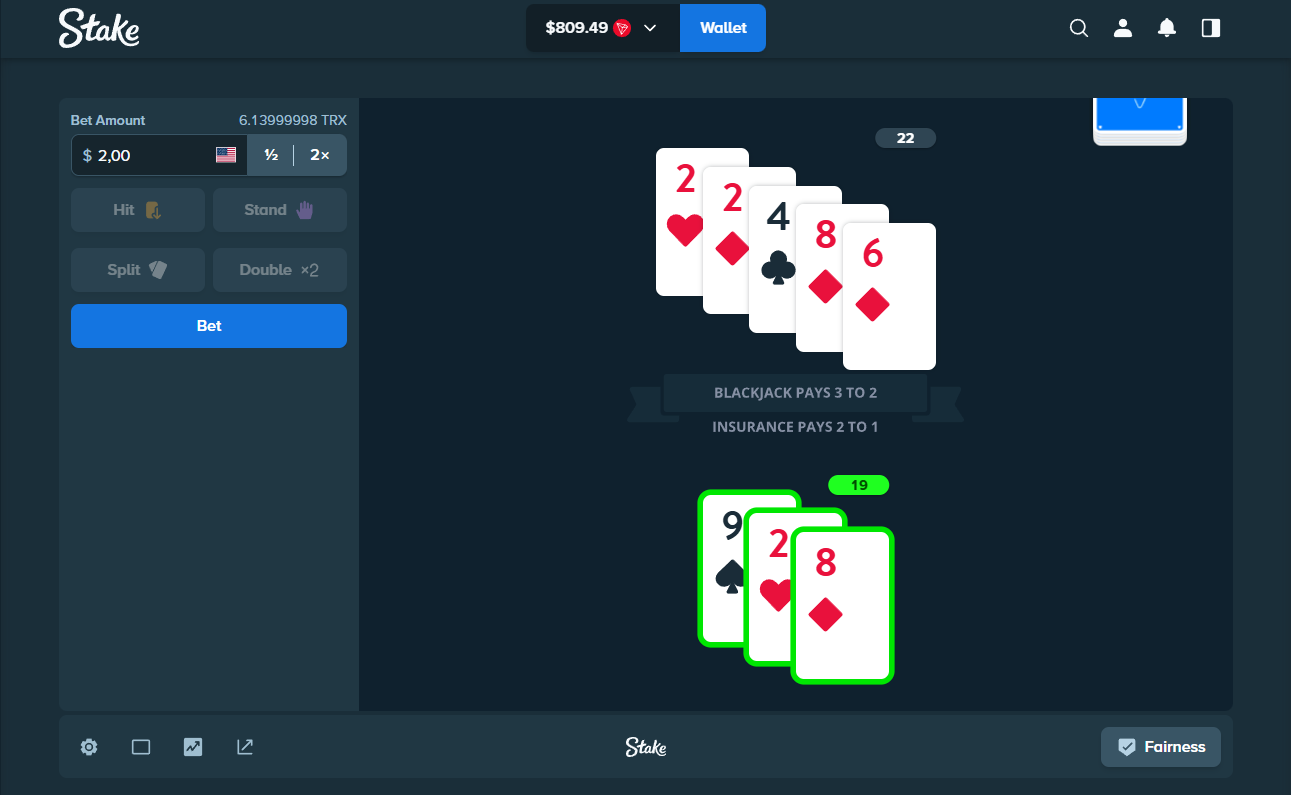
Stake Original Blackjack in pictures

Blackjack Strategy Table
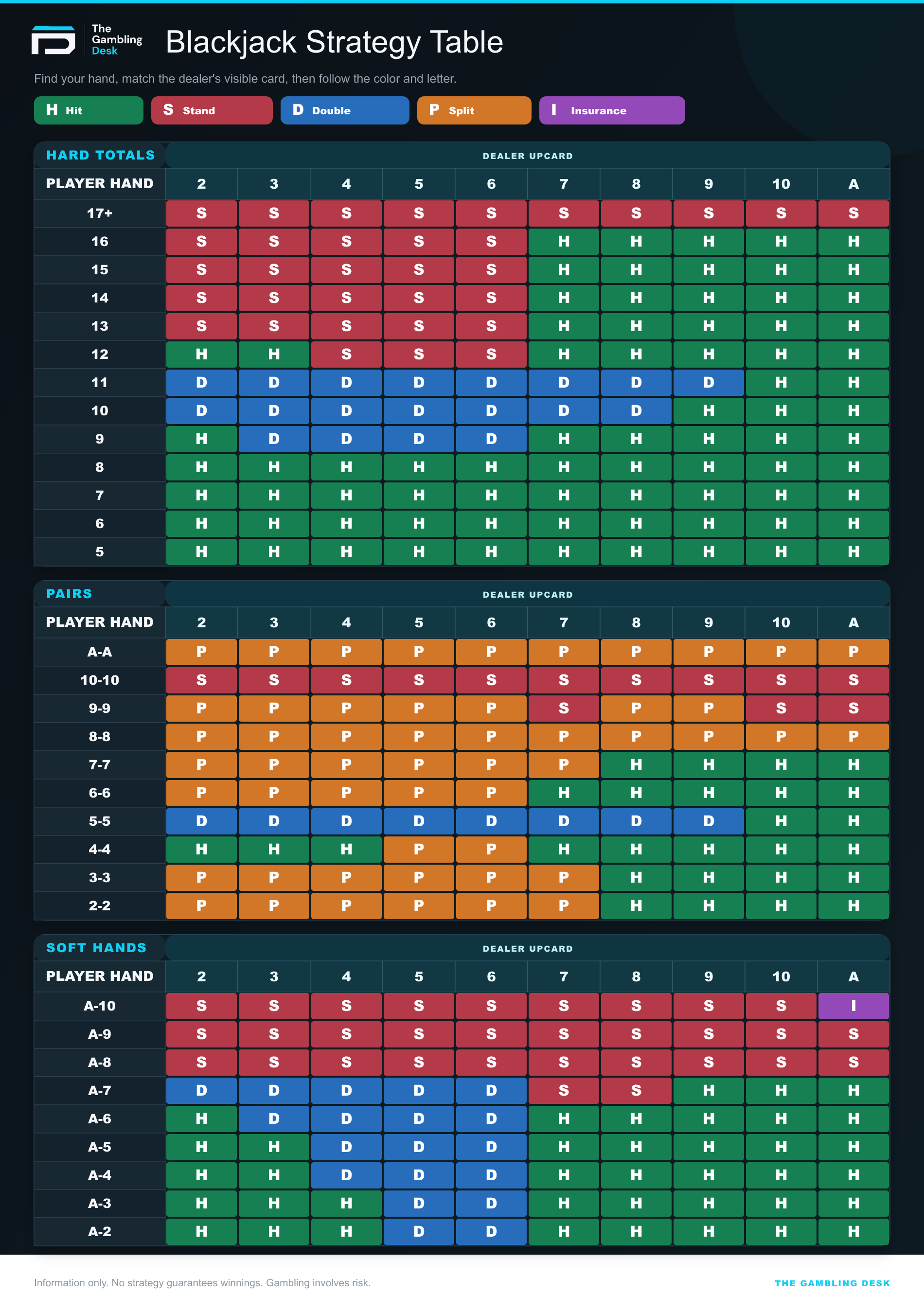
The first column separates hard totals, soft totals and pairs. The row corresponds to the player’s hand; the column corresponds to the dealer’s visible card, from 2 to Ace.
Understanding the Key
- H — Hit: draw a card;
- S — Stand: keep the current hand;
- D — Double: double the bet and generally receive only one additional card;
- P — Split: divide a pair into two hands;
- Insurance: a separate bet offered against an Ace, which must be distinguished from the main decision.
If an action such as Double or Split is not permitted at the table, the correct alternative depends on the rule and must be specified by the variant being used. Do not automatically replace Double with Hit without checking the table’s convention.
Hard Hand, Soft Hand or Pair
A hard hand contains no Ace counted as 11, or can no longer count one as 11 without exceeding 21. A soft hand contains an Ace that is still valued at 11: A‑6 is therefore a soft 17. A pair consists of two cards of the same value and may make the Split option available.
This distinction is essential. A hard 17 and a soft 17 have the same total, but the risk of exceeding 21 when drawing another card is not the same.
Reading Example
Suppose you have a hard 16 against the dealer’s 10. Find “Hard totals”, then row 16 and column 10. The table shows the action prescribed by the strategy for this variant.
With A‑7, use the soft hands section rather than the row for a hard total of 18. With 8‑8, consult the pairs section before deciding to play the total of 16 as an ordinary hand.
What the Table Does Not Take into Account
Basic strategy does not depend on an impression formed from the previous run, the size of the bet or the number of recent wins. It assumes specific rules and optimises the average decision without eliminating the house edge.
It must not be confused with card counting either. Card counting relies on other information and may be prohibited or impractical depending on the gaming context.
Blackjack and Provably Fair
The Stake Original version connects the cards to the provably fair system. Once the server seed is revealed, the client seed and nonce can be used to check the recorded deal. This is a retrospective check and does not reveal the next card. See our guide to Stake provably fair for the complete method.
The source information sheet gives a theoretical RTP of 99.43%, equivalent to a 0.57% house edge under the stated conditions. This figure assumes the correct application of a strategy suited to the rules; a different variant or different decisions will change the effective return.
Useful Questions
Why Is the Table in English?
The visual is designed as an international resource. The key above explains every action, and the French data file remains available for editorial integration.
Can This Table Be Used at Every Table?
Not without checking the rules. Decisions may vary according to the number of decks, the soft 17 rule, and the available doubling or splitting options.