

Stake Originals
Stake OriginalStake Diamonds: Colours, Groups and Multipliers
A guide to Stake Diamonds: five gems, seven colours, winning combinations, betting, Manual and Auto modes, and provably fair.
Published by The Gambling Desk ·
Diamonds reveals five gems in every round. The player chooses neither their colour nor their position: the payout depends solely on groups of matching colours in the final result.
Seven colours are used. The terms pair, two pairs, three of a kind, full house and four of a kind describe the groups, but Diamonds is not a poker variant and requires no decisions between gems.
How a Round Works
- Set the bet amount.
- Choose Manual or Auto mode.
- Start the round with Bet.
- Wait for the five gems to be revealed.
- Compare their colours with the displayed combinations and multipliers.
The result is complete as soon as all five positions have been filled. There is no option to hold, exchange or choose a colour.
Understanding the Diamonds Interface
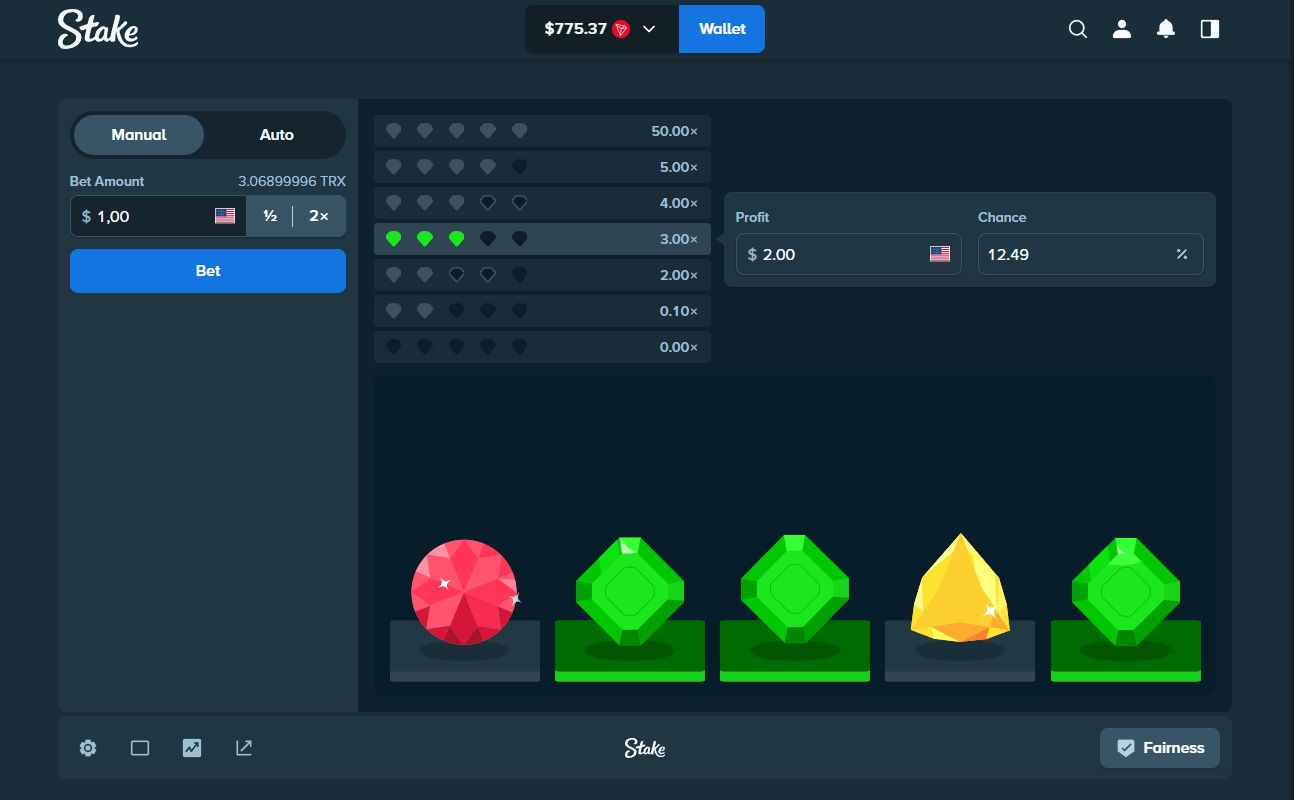
The screenshot shows the bet and Manual and Auto modes in the left-hand panel. The seven-combination payout scale appears at the top with the corresponding multipliers. The five gems occupy the central area; the profit and probability of the resulting combination are shown on the right.
The ½ button reduces the bet and 2x doubles it. When enabled in the settings, the instant-play option shortens the animation without changing the draw.
Inside the Stake interface
Stake Original Diamonds in pictures

Reading the Combinations
The seven documented results are:
- no match: five different colours, 0x;
- one pair: two matching colours, 0.10x;
- two pairs: two groups of two, 2x;
- three of a kind: three matching colours, 3x;
- full house: a group of three and a group of two, 4x;
- four of a kind: four matching colours, 5x;
- five matching gems: 50x.
A multiplier below 1x returns only part of the bet. The screenshot confirms these seven levels; it shows three green gems at 3x and a displayed probability of 12.49% for this combination.
The DOCX also contains these values, but there is no canonical branded CSV, JSON or PNG in the repository. They are therefore explained in prose, without an HTML table or invented data visual.
Manual and Auto Modes
In Manual mode, each round is started separately. Auto repeats the bet and can define a number of rounds, along with variations or stopping limits depending on the available options.
These automatic settings do not change the generated colours. An increase after a loss raises the amount committed to the next round without making a group more likely.
Tips and Limits
- read the multiplier as a total return, not only as profit;
- do not choose a bet based on previous colours;
- use a fixed bet to track your budget;
- limit the number of automatic rounds;
- disable instant play if the pace becomes difficult to follow.
A colour that has been absent for several rounds is not “due”. Previous results, gem positions and animations cannot predict the next combination.
Diamonds and Provably Fair
The Fairness access allows the recorded result to be checked with the server seed, client seed and nonce. This proof establishes the connection between the seeds and the round afterwards; it does not reveal the next five gems.
Our guide to Stake provably fair describes the method. The Dice guide provides a comparison with another direct relationship between probability and multiplier.
Frequently Asked Questions
How Many Gems Are Revealed?
Five gems are generated in every round from seven possible colours.
Can You Choose a Colour?
No. The player sets the bet but selects neither a colour nor a position. The result is based on the group generated.
Does a Pair Produce a Net Win?
No. A pair is displayed at 0.10x: it returns only a fraction of the bet. Payout and profit must be distinguished.