

Stake Originals
Stake OriginalStake Dice: Threshold, Probability and Multiplier
A guide to Stake Dice: Roll Over and Under, the 0 to 100 threshold, win chance, multiplier, and Manual, Auto and Advanced modes.
Published by The Gambling Desk ·
Dice produces a numerical result on a range from 0 to 100. The player does not target a specific number: they choose whether the result must be below a threshold with Roll Under, or above it with Roll Over.
The threshold simultaneously determines the winning area, displayed chance and multiplier. A wide area wins more often with a low payout; a narrow area wins less often with a higher payout.
How a Roll Works
- Set the bet amount.
- Choose Roll Over or Roll Under.
- Set the threshold with the slider or numerical field.
- Check the displayed multiplier and win chance.
- Place the bet: the numerical result appears on the range.
With Roll Over, the result must exceed the threshold. With Roll Under, it must remain below it. The switch button changes the side of the winning area while recalculating the other fields.
Understanding the Dice Interface
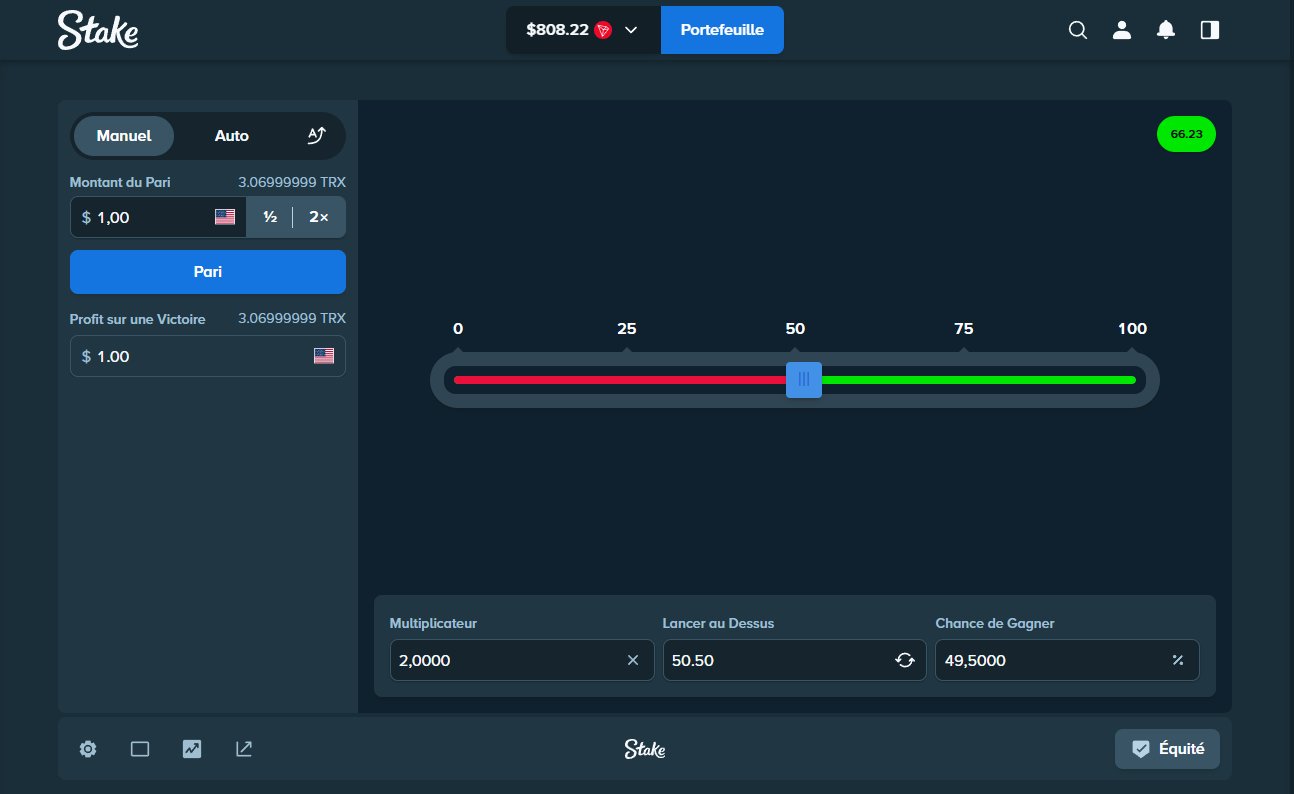
The central slider represents the range from 0 to 100. The side panel contains the bet and modes, while the bottom of the screen shows the multiplier, threshold and win chance.
In the screenshot, the configuration is Roll Over 50.50 with a displayed chance of 49.5000% and a multiplier of 2.0000x. The result of 66.23 is in the green area: it exceeds the threshold and is therefore a winning roll for this configuration.
The “Profit on Win” field distinguishes net profit from total return. With a bet of 1 unit and a multiplier of 2x, the total return is 2 units and the net profit is 1 unit.
Inside the Stake interface
Stake Original Dice in pictures

Probability and Multiplier
The relationship between chance and payout is inverse. Moving the threshold to cover more of the range increases the theoretical frequency of winning results but reduces the multiplier. Narrowing the area has the opposite effect.
A high chance does not make the configuration profitable. It generally replaces rare high wins with more frequent but lower wins, while losses remain possible.
The multiplier, threshold and chance form a single set: always check all three after changing the direction or value.
Manual, Auto and Advanced Modes
In Manual mode, every roll is placed separately with the visible configuration. Auto repeats bets for a specified number of rounds and can use stopping limits based on profit or loss.
The documented settings also allow the bet to be adjusted after a win or loss. The Advanced tab can combine conditions relating to factors including sequences, bet amount, chance, or switching between Over and Under.
These automatic settings do not change the roll. Increasing the bet after a loss can, on the contrary, cause the budget to be depleted much more quickly.
Comparison Example
A configuration close to a 50% chance produces a multiplier close to 2x. If the player narrows the winning area to target a higher multiplier, losing results necessarily become more frequent.
The proper use of the interface is to understand this trade-off, not search for a supposedly “hot” threshold. Previous rolls do not make an area more likely on the next round.
Tips and Limits
- check the Over or Under direction before every sequence;
- distinguish the displayed profit from the total return;
- set a loss limit before activating Auto;
- avoid bet progressions intended to recover losses automatically;
- do not infer a trend from a short sequence of results.
Changing volatility changes the distribution of results, not the game’s mathematical house edge. No threshold guarantees a profit.
Dice and Provably Fair
Dice provides a simple illustration of Stake provably fair. The server seed, client seed and nonce feed into a deterministic calculation that is converted into a numerical result. Once the server seed has been revealed, the roll can be reproduced.
See our guide to Stake provably fair for the procedure. Verification confirms the calculation afterwards; it cannot predict the next result.
Frequently Asked Questions
What Is the Difference between Roll Over and Roll Under?
Roll Over wins when the result exceeds the threshold. Roll Under wins when it is below the threshold. The interface then reverses the coloured area.
Does a High Win Chance Reduce the Risk to Zero?
No. It increases the theoretical frequency of wins but reduces the multiplier and always leaves a losing area.
Can Auto Mode Make a Strategy Profitable?
No. It executes the defined settings and conditions more quickly without changing the probabilities of the roll.