

Stake Originals
Stake OriginalStake Video Poker: Rules, Hands and Payouts
A guide to Stake Video Poker: five cards, Hold and Draw, winning hands, the visible payout scale, betting, and provably fair.
Published by The Gambling Desk ·
Video Poker deals five cards from a standard 52-card deck. The player chooses which cards to keep, replaces the others once, and the final hand is then compared with the displayed payout scale. The player does not compete against other participants: only the final ranking of the hand determines the payout.
The documented version is a Jacks or Better variant. A pair of Jacks, Queens, Kings or Aces is the lowest paying combination on the visible scale.
How a Game Works
- Set the bet amount.
- Deal the cards with Bet.
- Examine the five cards received.
- Activate Hold on every card you want to keep.
- Use Draw to replace all cards that were not held.
- Read the final hand and any resulting payout.
A held card remains in place; every other card is replaced. The hand is final after this draw: there is no second exchange.
Understanding the Video Poker Interface
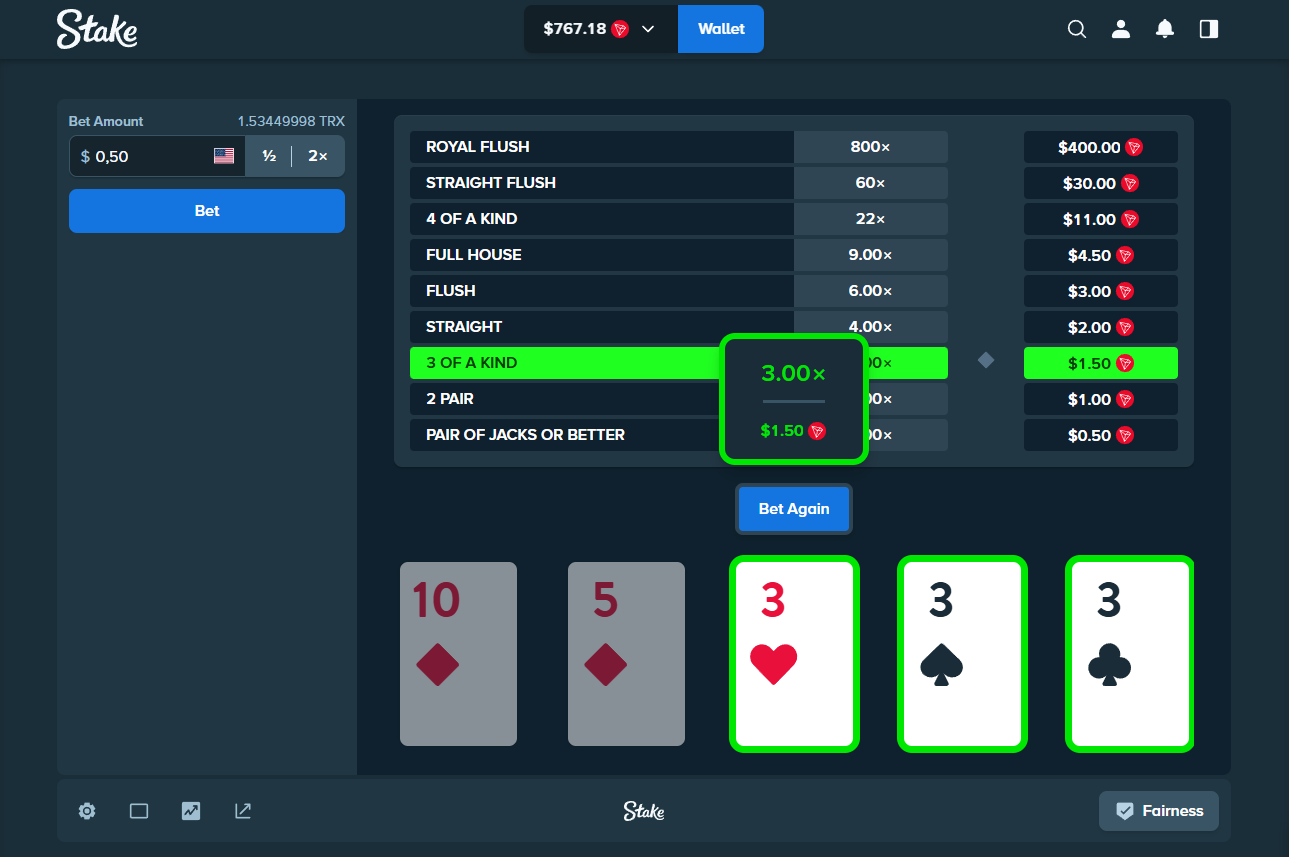
The screenshot shows the bet amount and Bet button on the left. The payout scale occupies the top of the screen, with the five cards aligned below it. After a hand, the recognised combination, its multiplier and corresponding return are highlighted.
The ½ button reduces the bet and 2x doubles it. The screenshot does not show an Auto mode: Video Poker requires a holding decision between the initial deal and final draw.
Inside the Stake interface
Stake Original Video Poker in pictures

Winning Hands and the Visible Payout Scale
The displayed hierarchy runs from a pair of Jacks or Better to a royal flush. The screenshot confirms the following payouts for the displayed bet: Jacks or Better 1x, two pair 2x, three of a kind 3x, straight 4x, flush 6x, full house 9x, four of a kind 22x, straight flush 60x and royal flush 800x.
A straight consists of five consecutive ranks. A flush consists of five cards of the same suit. A full house combines three of a kind with a pair; four of a kind contains four cards of the same rank. A straight flush combines a straight and flush, while a royal flush is a straight flush from 10 to Ace.
The legacy DOCX omits the straight flush from its table, while the UI screenshot clearly displays it at 60x. No canonical branded CSV, JSON or PNG exists in the repository, so the page explains the payout scale in prose and does not publish a table.
Which Cards Should You Hold?
The right choice depends on both the dealt hand and active payout scale. A made combination, a paying pair or a four-card draw towards a strong hand must not be handled in the same way.
A simplified rule cannot replace a complete strategy suited to this payout scale. Always chasing a royal flush, automatically breaking up a pair or holding cards merely because they have just appeared can impair decisions. Strategy reduces certain mistakes but guarantees no result.
Bet, Pace and Limits
The return amount equals the bet multiplied by the coefficient for the final hand. A coefficient of 1x returns the bet without net profit; a hand absent from the payout scale loses the bet.
Shortcuts or interface acceleration reduce the time between games without improving the cards. A fixed bet and defined budget make swings easier to understand than a progression after a loss.
Video Poker and Provably Fair
The Fairness access visible in the interface allows a game to be checked using the server seed, client seed and nonce. This verification takes place after the result and does not reveal the next cards.
Our guide to Stake provably fair explains this procedure in detail. To compare card decisions without confusing the rules, also see the Blackjack guide.
Frequently Asked Questions
How Many Cards Can You Replace?
All five initial cards can be replaced except those placed on Hold. There is only one replacement draw.
What Is the Lowest Paying Hand?
In the visible variant and table, you need at least a pair of Jacks, Queens, Kings or Aces.
Does Strategy Let You Win Every Game?
No. It helps choose which cards to hold according to the payout scale, but the final cards remain random and a correct decision can lose.