

Tables / Stake Originals
Stake OriginalStake Moles: Rules, Moles and Multipliers
A guide to Stake Moles: choosing 1 to 6 moles, hits, cashout, Manual and Auto modes, and the multiplier table.
Published by The Gambling Desk ·
Moles follows the principle of the fairground game: several positions are visible, but only some contain a mole to hit. Every successful hit increases the multiplier. Selecting a losing position ends the round and forfeits the bet; cashout lets you stop before making that mistake.
The player chooses between one and six moles. The more moles there are among the seven positions, the more likely the first hit becomes and the more slowly the multiplier grows.
How to Play Stake Moles
- Set the bet and number of moles.
- Start the round to distribute the moles among the seven positions.
- Select a position or use random selection.
- A successful hit increases the multiplier and allows play to continue.
- Cash out the displayed return or attempt another hit; a losing position ends the round.
Random selection only chooses a position on your behalf. It does not detect the moles or improve the probabilities.
Understanding the Moles Interface
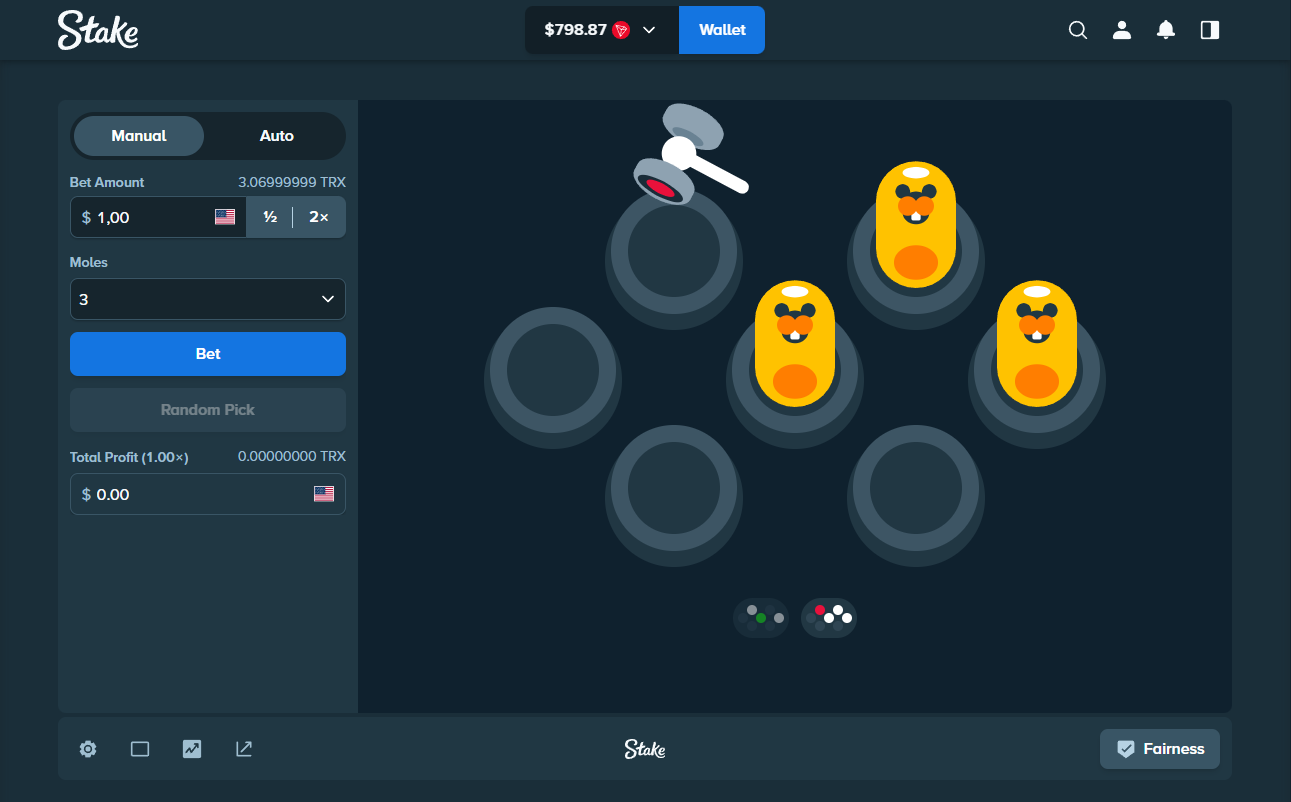
The seven positions occupy the centre of the screen. The side panel contains the mode, bet, number of moles and random selection.
The screenshot shows a three-mole configuration. The hammer represents the choice made, while the colours of the moles and markers make the result visible. The total profit and current multiplier appear in the panel.
Inside the Stake interface
Stake Original Moles in pictures

Number of Moles and Game Modes
The setting ranges from 1 to 6 moles. With six moles, six of the seven positions are favourable on the first selection and the table starts at 1.14x. With only one mole, one of the seven positions is favourable and the first hit corresponds to 6.86x.
In Manual mode, the player chooses every position and decides when to cash out. Auto mode notably allows you to set the bet, number of moles, target number of hits, number of rounds, and profit or loss limits.
These settings change the pace and financial exposure, not the positions of the moles.
Moles Multiplier Table
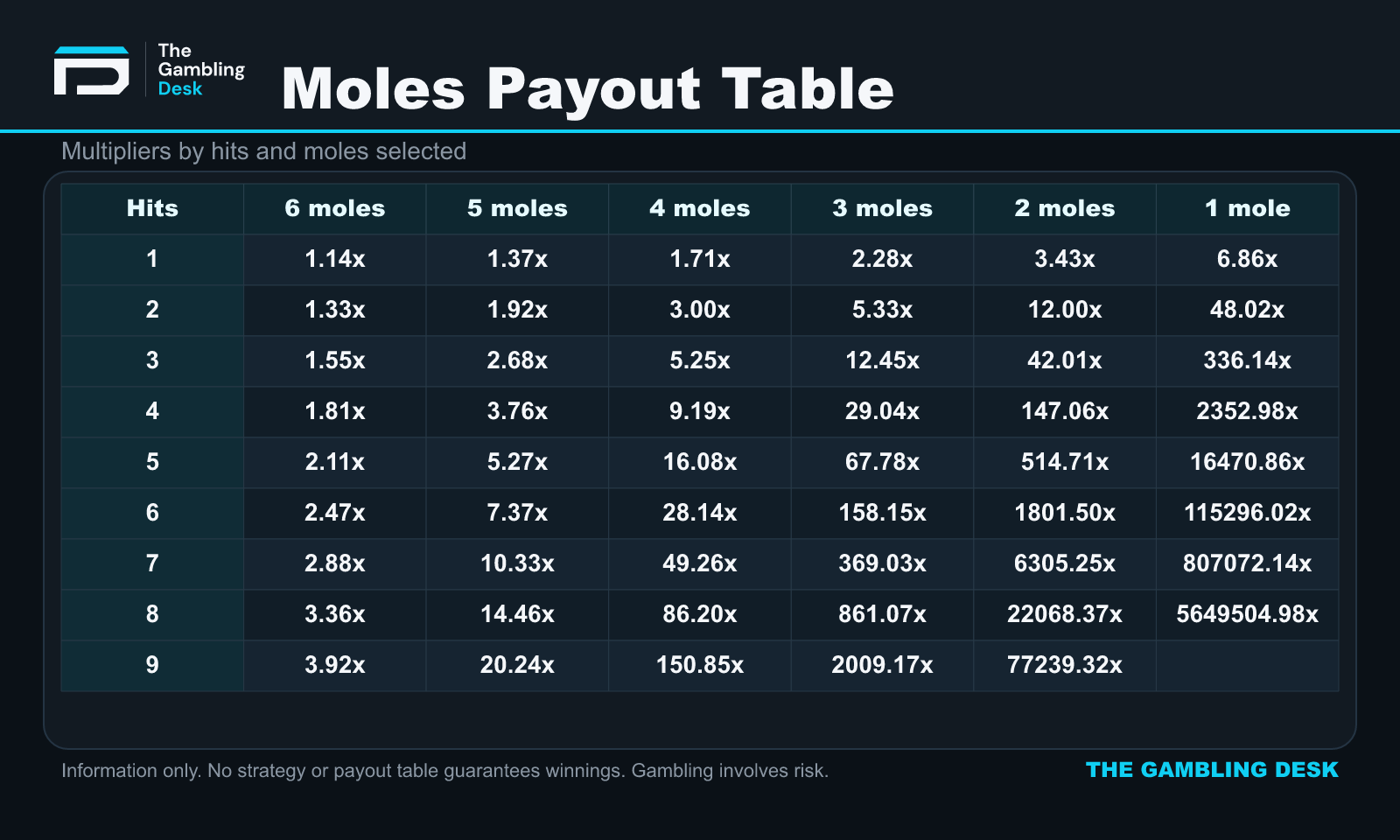
The rows correspond to the number of successful hits. The columns run from six moles to one mole. First choose the column for the configuration, then move down to the number of hits achieved. The branded PNG can be opened at full size.
With six moles, one hit shows 1.14x and five hits show 2.11x. With only one mole, one hit shows 6.86x and five hits show 16,470.86x. This very high value corresponds to an exceptionally difficult sequence.
Blank cells indicate combinations that are impossible with the selected number of moles. They do not represent a zero payout.
Calculating the Return
A bet of 2 units cashed out at 5.25x produces a total return of 10.50 units, including the bet. The net profit is 8.50 units.
This return is only secured after cashout. If the next selection is a losing one, the round ends and the previously displayed multiplier is not paid.
Tips and Risks
- check the number of moles before starting the round;
- compare several columns on the same row of the table;
- use Random Pick as a shortcut, never as a strategy;
- set a hit limit before automating a sequence;
- do not attempt to recover a loss by mechanically increasing the bet.
Adding moles increases the probability of a hit but reduces its payout. This does not create a risk-free or profitable long-term configuration.
Moles and Provably Fair
Stake documents Moles as one of its multi-event provably fair games. Once the server seed has been revealed, the positions can be recalculated using the client seed, nonce and bet data. This proof remains retrospective and reveals nothing before the selection.
See our guide to Stake provably fair to understand this mechanism.
Frequently Asked Questions
Do More Moles Mean More Winnings?
No. A higher number of moles makes each hit more likely, but the associated multiplier is lower.
Can You Cash Out after a Hit?
Yes. After a favourable result, cashout ends the round at the displayed multiplier.
Does Random Pick Know the Right Positions?
No. This control makes a random choice and has no information about the hidden distribution.