

Stake Originals
Stake OriginalStake Keno: Numbers, Hits and Multipliers
A guide to Stake Keno: the 40-tile grid, selecting 1 to 10 numbers, the 10-number draw, difficulty levels, hits, and Manual and Auto modes.
Published by The Gambling Desk ·
Stake Keno uses a grid of 40 numbered tiles. The player selects between 1 and 10 numbers, then the game draws 10 numbers. The payout depends on the number of matches — or hits —, the number of tiles selected and the difficulty.
Numbers have no memory. A tile that has been drawn frequently or rarely in recent rounds is no more predictive of the next one.
How to Play Stake Keno
- Set the bet.
- Choose a difficulty.
- Select between 1 and 10 numbers on the grid, or use Random Pick.
- Check the payout scale for the number of selections.
- Place the bet and compare your choices with the 10 numbers drawn.
A hit is a number that was both selected by the player and drawn by the game. The applicable multiplier appears on the row corresponding to the number of hits.
Understanding the Keno Interface
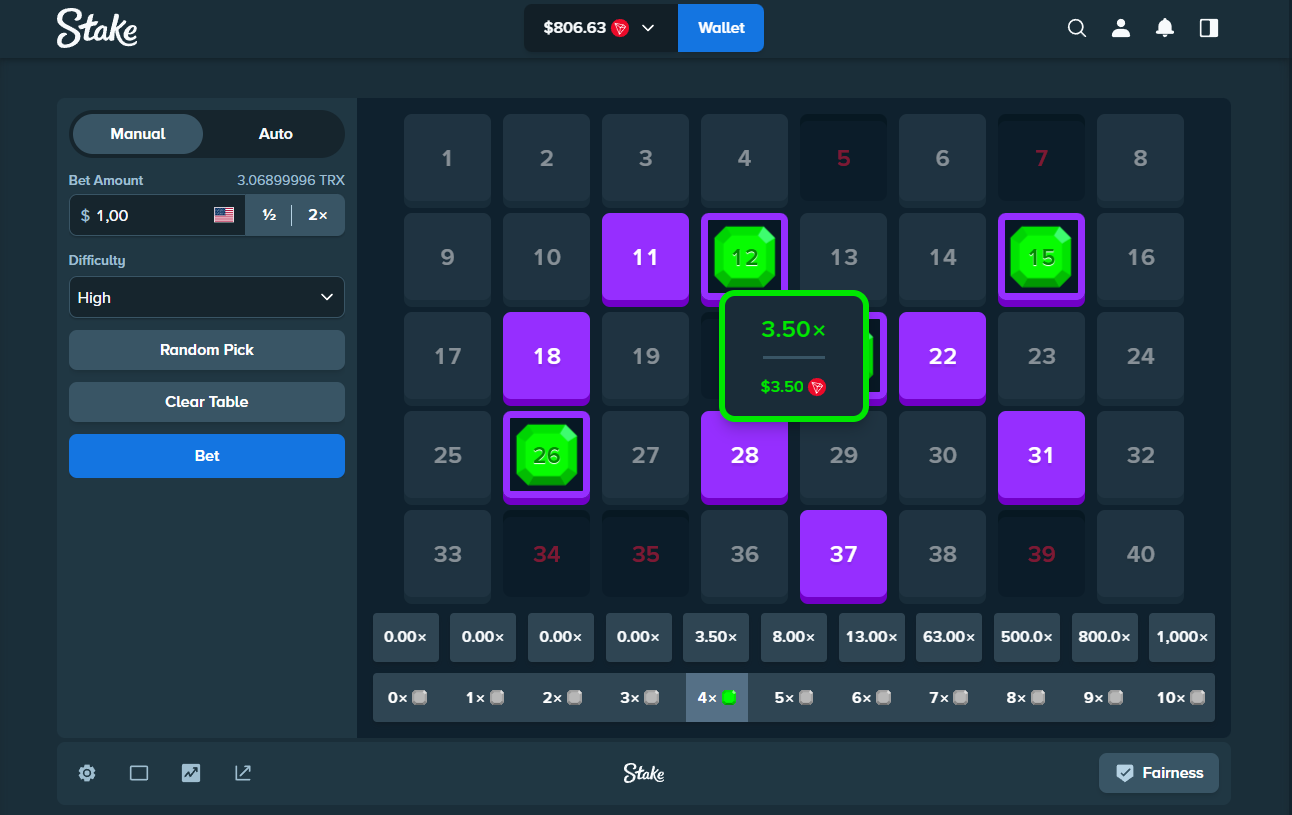
The screenshot shows Manual and Auto modes, the bet, difficulty, random selection and reset controls in the left-hand panel. The grid numbered from 1 to 40 occupies the centre, with the hit payout scale below it.
In the example, ten numbers are selected at High difficulty. Four matches produce 3.50x. The other visible multipliers belong to this specific configuration; they change with the number of selections and risk level.
Inside the Stake interface
Stake Original Keno in pictures

Selections, Draw and Payouts
Choosing more numbers increases the maximum possible number of hits but changes the entire payout scale. This does not automatically mean that a profitable result becomes more frequent.
Manual selection and Random Pick have the same probabilities for an identical number of selections. Random Pick is only a shortcut. Clear Table removes the choices before the next bet.
The payout scale may contain 0x, partial returns below 1x and higher multipliers. You must therefore read the entire row corresponding to the number of tiles played, not only the maximum payout.
Difficulty and Game Modes
Difficulty changes the multipliers associated with the hits. A higher level generally concentrates the largest payouts on rarer matches and may assign 0x to more results.
In Manual mode, each grid is confirmed separately. Auto repeats the selected configuration across multiple rounds. Set a number of bets and a loss limit: the rapid pace can accumulate many bets in a short time.
Tips and Limits
- check the number of selections before starting;
- review the payout scale after every change of difficulty;
- do not confuse hits with net profit;
- use Random Pick as a shortcut, not as a strategy;
- disregard ideas about hot or cold numbers;
- do not increase the bet to compensate for a draw without a hit.
Keeping the same numbers or changing them every round does not alter their future probability. No selection system circumvents the house edge.
Keno and Provably Fair
The 10 drawn numbers can be verified using the round’s provably fair data. Once the server seed has been revealed, the client seed and nonce can reproduce the generation.
See our guide to Stake provably fair. This verification confirms the draw afterwards without predicting the next one.
Frequently Asked Questions
How Many Numbers Can You Choose?
The observed interface allows between 1 and 10 numbers to be selected on a 40-tile grid. The game then draws 10 numbers.
Does Random Pick Improve the Chances?
No. It chooses the tiles automatically, with the same probabilities as a manual selection of the same size.
Does a Number Become More Likely after a Long Absence?
No. Previous draws do not impose any compensation on the next round.