

Stake Originals
Stake OriginalStake Cases: Cases, Difficulty and Multiplier
A guide to Stake Cases: opening a case, the multiplier reel, four difficulty levels, Manual and Auto modes, history, and provably fair.
Published by The Gambling Desk ·
Stake Cases turns opening a virtual case into an instant-result round. You set the bet and difficulty, then Bet spins a reel of cases. The case that stops beneath the indicator reveals the multiplier applied to the round.
The choice concerns the risk level, not a specific case. The result is determined when the reel stops.
How a Round Works
- Set the amount in Bet Amount.
- Choose a difficulty.
- Press Bet.
- The reel spins beneath the central indicator.
- The selected case opens and displays its multiplier.
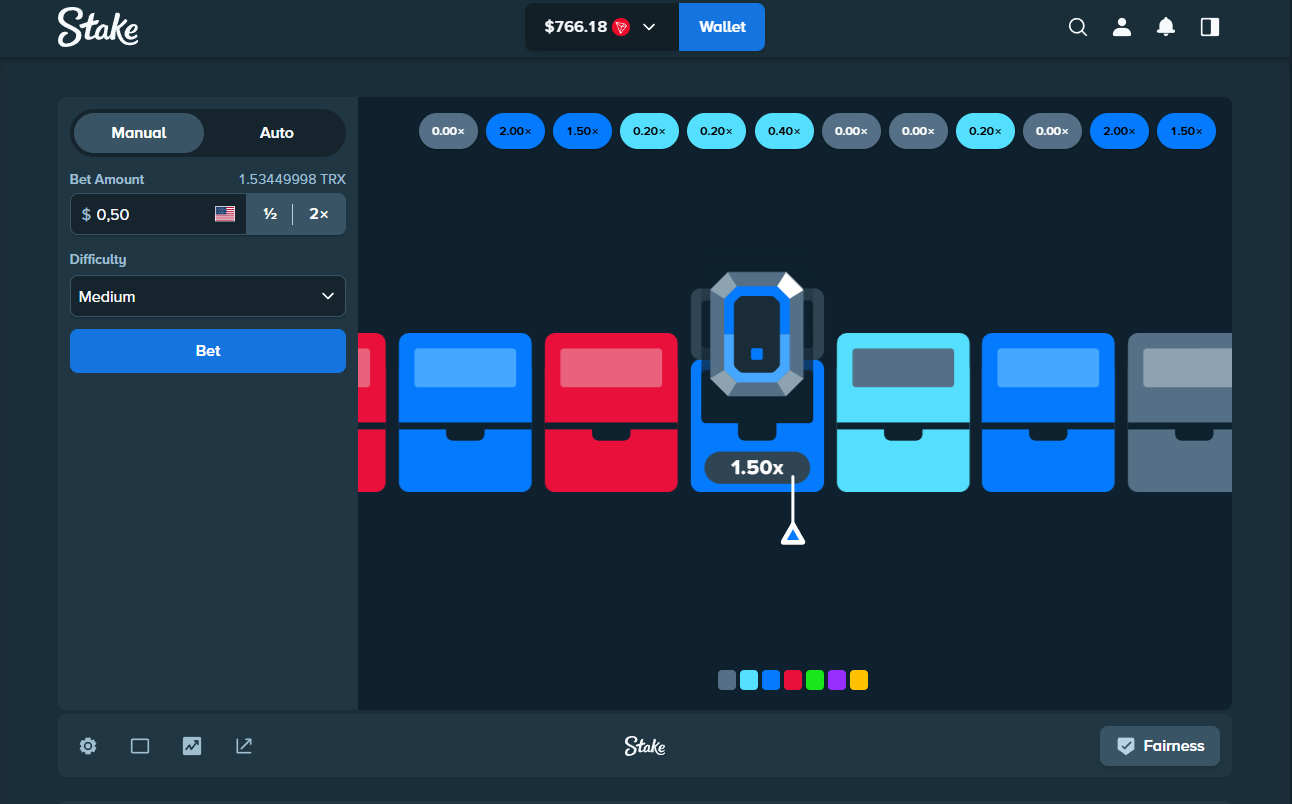
The supplied screenshot shows the Medium level and a case at 1.50x. For a bet of 0.50, this multiplier would correspond to a total payout of 0.75 and a net profit of 0.25.
Understanding the Cases Interface
The Manual and Auto modes appear at the top of the left-hand panel. Bet Amount lets you enter the bet; the adjacent shortcuts halve or double it. The Difficulty menu selects the distribution profile.
The reel occupies the main area. Cases in different colours pass beneath a fixed arrow, and the central case displays its value after the reel stops. The upper row keeps the latest visible multipliers: it is used to review recent rounds, not predict the next one.
The screenshot notably shows results of 0.00x, 0.20x, 0.40x, 1.50x and 2.00x. This sequence only describes the history displayed when the screenshot was taken.
Inside the Stake interface
Stake Original Cases in pictures

The Four Difficulty Levels
The legacy DOCX distinguishes Easy, Medium, Hard and Expert. Difficulty changes the distribution of multipliers. Raising the level increases the spread of results: high values may be paired with more low or zero outcomes.
This setting does not make a colour or position predictable. A case that passed close to the indicator is no more likely to be selected on the next round.
The RTP, house-edge and maximum-multiplier figures mentioned in the DOCX are not presented as current characteristics. No canonical data independent of the legacy material confirms them in the available files.
Total Payout, Profit and Loss
The multiplier applies to the bet. At 1.50x, a bet of 0.50 returns 0.75 in total: the 0.50 bet and 0.25 in profit. At 0.20x, the same bet would return 0.10 and incur a net loss of 0.40. At 0.00x, no amount is returned.
Comparing the multiplier with 1.00x explains the result:
- above 1.00x, the round produces a profit;
- at 1.00x, the bet is returned without a profit;
- below 1.00x, only part of the bet is returned;
- at 0.00x, the bet is lost.
A high value remains a random result. Previous rounds do not make a particular case “due”.
Manual and Auto Modes
Manual requires an action for every round and gives you time to check the bet and difficulty. Auto repeats the selected configuration. It changes neither the distribution nor the probabilities.
The DOCX describes automatic settings for the number of rounds and session limits. The precise interface for these settings does not appear in the screenshot, so only their principle and control function are retained here.
Before starting Auto, calculate the maximum exposure: the amount of one bet multiplied by the number of rounds. A progression after a loss rapidly increases this total without guaranteeing recovery.
History and Limits
The upper history is useful for checking multipliers already obtained. It does not represent an exploitable trend. Every new round must be approached independently.
A fixed bet, loss limit and defined duration make the session easier to track. Changing difficulty after an unfavourable run does not correct past results.
Cases and Provably Fair
The Fairness button opens the provably fair system. The server seed, client seed and nonce allow the result associated with a round to be verified afterwards. This check does not reveal the next case.
Our guide to Stake provably fair explains the procedure. Bars adds together several selections on a grid, while Wheel uses a wheel of multipliers.
Frequently Asked Questions
Can You Choose Which Case Will Be Opened?
No. The player sets the bet and difficulty; the reel then determines which case stops beneath the indicator.
What Does Difficulty Change?
It changes the distribution of multipliers and therefore the volatility of the round. It cannot predict the result.
Does the History Help Find the Next Value?
No. It summarises recent rounds, but a succession of low multipliers does not make a high value more likely.