

Stake Originals
Stake OriginalStake Baccarat: Player, Banker and Tie
A guide to Stake Baccarat: Player, Banker and Tie bets, card values, the third-card rules, payouts, Manual and Auto modes, and provably fair.
Published by The Gambling Desk ·
Stake Baccarat asks you to bet on the outcome of an automated deal. You choose Player, Banker or Tie before starting the round; the game then deals the cards and applies the drawing rules without requiring any further decision from the player.
The objective is not to build a hand. It is to identify which side will finish with a total closest to 9, or to predict a tie.
How a Round Works
- Choose the chip value.
- Place one or more bets on Player, Banker or Tie.
- Check the Total Bet.
- Start the deal with Bet.
- The game deals two cards to each side and, if required by the rules, adds a third card.
- The winning area and total return appear in the centre.
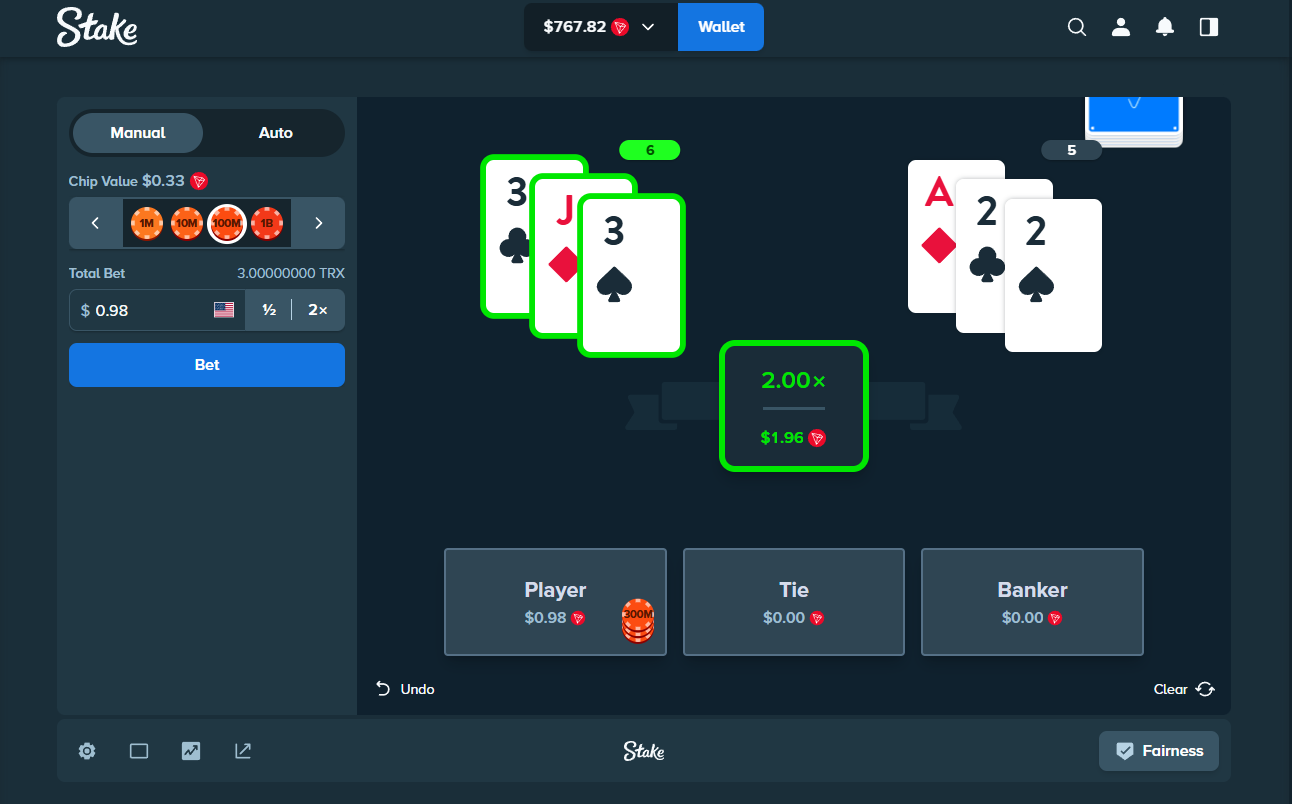
The screenshot shows a bet of 0.98 on Player, a Player hand totalling 6 against a Banker hand totalling 5, and a displayed return of 2.00x, or 1.96 in total. The next deal remains independent of this result.
Card Values and Totals
The Ace is worth 1. Cards from 2 to 9 retain their face value. Tens and picture cards are worth 0. When the sum exceeds 9, only the final digit is kept: a hand containing 7 and 8 is therefore worth 5.
An initial total of 8 or 9 is called a natural and ends the deal. The legacy DOCX states that Player stands on 6 or 7 and draws on 0 to 5. The Banker rules then depend on its total and, when Player has drawn, the value of that third card. The interface applies this table automatically: no drawing decision is requested after the bet.
Understanding the Baccarat Interface
The Manual and Auto tabs are visible in the left-hand panel. Chip Value sets the value of the chip; the arrows move through the available values. Total Bet adds together the chips placed, while the amount shortcuts halve or double the displayed bet.
The three Player, Tie and Banker areas occupy the bottom of the table. Undo removes the latest action and Clear clears the bet slip. The panel on the right shows the shoe and dealt cards. A vertical history keeps the latest results, while Fairness opens the verification module.
Auto mode is available, but its detailed settings are not shown in the supplied screenshot. It automates rounds; it changes neither the dealing rules nor the probabilities.
Inside the Stake interface
Stake Original Baccarat in pictures

Player, Banker and Tie
The legacy DOCX describes the following net payouts:
- Player: 1 to 1;
- Banker: 0.95 to 1, corresponding to a 5% deduction from the winnings;
- Tie: 8 to 1.
The screenshot confirms that a Player win displays 2.00x as the total return. With a bet of 0.98, the player receives 1.96: the net profit is 0.98 after deducting the initial bet.
For Banker and Tie, the DOCX expresses a net win, while the interface may show a total-return multiplier. You must therefore always check whether the displayed value includes the bet. On a tie, the Tie bet wins; the exact treatment of Player and Banker bets on a Tie is not sufficiently visible in the current resources to be presented as confirmed here.
Payout, Commission and Risk
According to the legacy documentation, Banker pays less than a Player win because of the built-in commission. Tie offers a higher payout because that outcome is less frequent. A higher multiplier does not mean that the bet becomes more favourable.
The house-edge and RTP percentages published in the DOCX are not presented as current data because no canonical source independent of the legacy material was found in the repository.
History and Strategies
The history is useful for reviewing results, not predicting the next deal. A run of Player, Banker or Tie does not make any outcome “due”.
Martingale, Fibonacci or any other progression only changes the size of the bets. It changes neither the distribution, payouts nor mathematical house edge. A fixed bet and loss limit make exposure easier to track.
Baccarat and Provably Fair
The Fairness button allows a round to be verified using elements from Stake’s cryptographic system, including the seeds and nonce. This verification occurs after the result and does not reveal the next hand.
Our guide to Stake provably fair explains the mechanism in detail. Blackjack and Video Poker provide two other card-based Stake Originals for comparison.
Frequently Asked Questions
Do You Have to Decide Whether to Draw a Third Card?
No. After the bet, Stake Baccarat automatically applies the dealing rules to Player and Banker.
What Does 2.00x Mean on a Player Win?
It is the visible total return. A bet of 0.98 therefore produces 1.96, for a net profit of 0.98.
Does Auto Mode Improve the Chances?
No. It automates the rounds but changes neither the rules, payouts nor probabilities.